Venture Capital & Startup Funding Roundup, June 9, 2026
 Nickie Louise
Posted On June 9, 2026
Nickie Louise
Posted On June 9, 2026
It’s Tuesday, June 9, 2026, and venture investors continue to write large checks—but only for companies operating at the intersection of AI, infrastructure, automation, and strategic technology. Funding activity was lighter than usual over the past 12 hours, yet the deals that did emerge offer a revealing snapshot of where capital is concentrating and which sectors are commanding investor attention.
In the past half-day, investor focus has sharpened on real-world AI and infrastructure. A record-setting robotics startup raised $200 million to build made-in-America AI-driven factories, while a European satellite pioneer closed a €450 million round to expand space-based intelligence for defense and resilience. At the same time, climate and transportation tech saw fresh capital: an EV-trailer maker secured $30 million to deploy hybrid off-grid RVs, and a weather-sensing network raised €6.5 million to transform telecom towers into atmospheric sensors. Even data and health tech have drawn strategic funding: an AI-native analytics platform secured $14 million, and a UK nutrition-tech company raised €16 million to scale AI-powered supplements.
These deals underscore two emerging themes. First, physical AI acceleration – deploying machine intelligence in factories, on roads, and in orbit – is driving large rounds. Investors appear convinced that gains in AI algorithms will pay off only if matched by new hardware and data infrastructure. Second, sovereign and climate priorities are surfacing. European backers are pouring money into dual-use space and environmental data companies, signaling concern about strategic independence and climate adaptation. Collectively, today’s funding suggests that after a frenzy of broad AI hype, capital is now homing in on applications that meet tangible needs in defense, manufacturing, energy, and health.
The Macro Environment: Physical AI and Sovereign Tech.
Venture markets are still awash in capital, especially for deep tech. Global funding hit an all-time quarterly peak in Q1 2026, with investors rushing into AI (Crunchbase reports roughly $300 billion invested in startups that quarter). Much of that went into a few giant AI labs, but new data this week shows the spillover into hardware and infrastructure: hundreds of millions are flowing into robotics, space assets, and climate tech. This pattern reflects investor psychology shifting from pure software to more tangible assets. Buyers of venture capital have signaled that they want AI muscle for the physical world – industrial robots, satellites, and even autonomous vehicles – not just cloud services. In effect, venture capital is answering calls to “onshore” critical tech and deploy it to national priorities.
Several forces converge here. Public markets are bumpier, so VCs are motivated to back companies with a strong moat and visible revenue potential. Hardware and climate-tech businesses often require more capital and longer timelines, but also promise locked-in contracts (e.g., defense suppliers or utilities). In addition, governments are explicitly nudging private investment into strategic areas. Europe, in particular, has made clear that space-based intelligence and “dual-use” tech are national priorities. ICEYE’s €450M raise – to supply satellites for both civilian and defense use – fits into that paradigm. Similarly, concerns about climate and energy are leading VCs to fund startups that can measure or manage resource use (as seen in the Skyfora and EV-trailer rounds).
Finally, the macro backdrop still includes huge AI hype. With very cheap capital (low interest rates and massive wealth in fund pools), investors have ample dry powder and are looking for the next big hardware plays. We see this in today’s mix: late-stage funding is still surging (backing Series C/F deals), but early-stage is also picking up, with returns looking achievable. In this environment, investor themes are crystallizing around AI-driven infrastructure – both digital (analytics platforms) and physical (robots, satellites, sensors). We expect this focus will sharpen: VCs want to ensure that AI’s promise is locked into supply chains, national security, and business operations, not just software demos.
Standard Bots raises $200 million to scale Made-in-America industrial robots
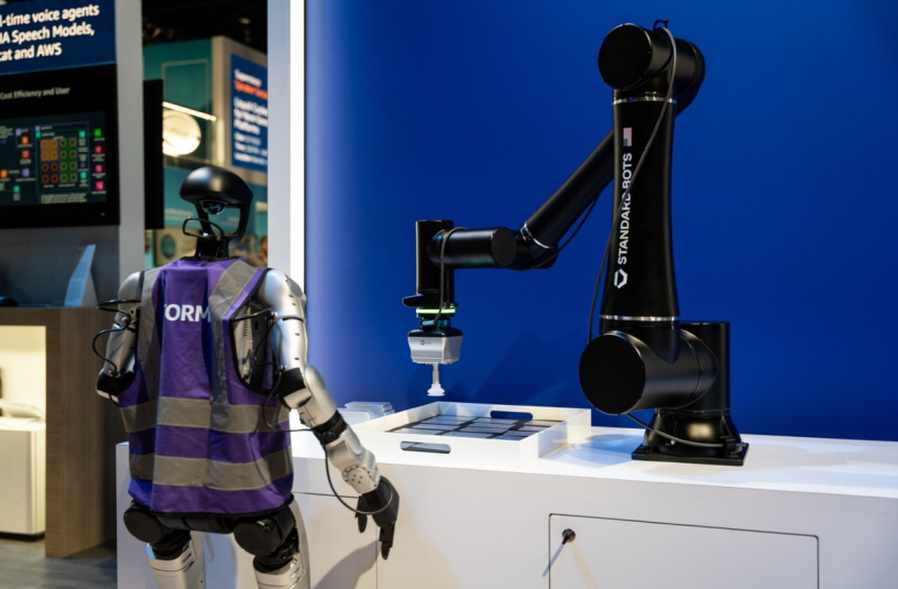
Standard Bots, a US industrial robotics startup, has closed a $200M Series C (at a $1.0B valuation) to expand its factory automation platform. The New York company builds AI-native “lights-out” manufacturing robots and hopes to capture roughly 10% of new U.S. robot deployments within a year. The round was led by RoboStrategy and General Catalyst, with participation from investors including Amazon’s Alexa Fund, Samsung Next, BoxGroup and GiantLeap Capital. Proceeds will fund a 70,000-square-foot plant in Glen Cove, NY – a significant expansion of its vertically integrated production – and accelerate hiring in engineering and operations.
Standard Bots’ core offering uses machine learning to simplify robot programming. Rather than coding each task, technicians can “teach” the robots by demonstration, making the systems flexible across assembly, welding, palletizing, inspection, and more. Investors have snapped up these Series C shares because Standard Bots promises to lower costs (its systems claim to have a unit price about 30% lower than incumbents) while delivering a U.S.-based manufacturing solution. That aligns with a recent push by the U.S. government and industry to onshore automation hardware. Indeed, the CEO testified before Congress on a national robotics strategy, and the startup cites interest from defense contracts (Lockheed, Army, NASA) to bolster its case for “national manufacturing resilience”.
The funding matters on multiple fronts. First, it signals continued VC appetite for “physical AI” – applying machine learning to real-world machinery. In practice, Standard Bots now has ample capital to ramp factory output, which could force legacy suppliers to respond or risk falling behind. Second, the lead investors (RoboStrategy and GC) are both well known for hardware bets, thereby validating industrial robotics as an investable category. In the broader landscape, this raise highlights the trend toward large late-stage rounds focused on fundamental infrastructure rather than hype sectors. A $200M Series C in robotics is unusual in this era of software deals, underlining that investors believe there is both a market need and pricing power here. Finally, with automation demand rising in virtually every industry, Standard Bots is up against entrenched incumbents (such as Fanuc and ABB) and newer challengers (e.g., legacy 3PLs adding robotics). But its combination of cost, U.S. production, and AI-powered ease of use sets it apart. If Standard Bots can deliver on scale – something the new factory will enable – it could be a clear leader in bringing advanced automation to traditional manufacturing.
Funding Details
Startup: Standard Bots
Investors: RoboStrategy (lead), General Catalyst (co-lead), plus Amazon Alexa Fund, Samsung Next, Box Group, GiantLeap Capital
Amount Raised: $200 million
Total Raised: $220 million (approx.)
Funding Stage: Series C
Funding Date: June 9, 2026
Headquarters: Glen Cove, NY, USA
Sector: Industrial Robotics / Automation
ICEYE raises €450 million in funding to boost space-based intelligence and surveillance

Finland’s ICEYE – a satellite firm specializing in radar imagery – announced a €450M Series F funding round (post-money >€10 billion) led by General Atlantic. The Espoo-based startup will use the capital to build more radar satellites and expand its analytics platform for governments and defense agencies. This raise is Europe’s largest space-tech round in years, and it comes with heavyweight backers: besides GA, investors include national funds (Finland’s Solidium), pension giants (Varma, Ilmarinen), Nokia, Qatar Investment Authority and venture firms like TCV. A secondary share sale was also arranged, bringing the total Series F package beyond €1 billion.
ICEYE’s business serves what it calls “sovereign intelligence from space”. Its satellites use synthetic-aperture radar to image Earth through clouds and darkness, providing near-real-time observation for mapping, security, and disaster response. Recent contract wins in NATO countries and with U.S. agencies have validated the demand for this capability. As CEO Rafal Modrzewski notes, the caliber of investors “reflects a shared belief” that governments need their own space surveillance infrastructure. Indeed, this round underscores a geopolitical facet: Europe is eager to build independent space intelligence capabilities (rather than rely on U.S./Russian providers), and ICEYE now has the war chest to rapidly strengthen its constellation.
Strategically, the ICEYE deal signals a massive influx of capital into defense-oriented AI infrastructure. Radar satellites feed AI analytics (e.g., change detection, terrain modeling), so ICEYE sits at the intersection of AI, remote sensing, and national security. The company’s $10B+ valuation confirms that investors are betting a lot on space data as the next frontier. For entrepreneurs and startups, this round sets a bar: it suggests that if you can offer unique, high-barrier tech for government use, enormous rounds are possible even in tough financing markets. For the market, it points to an intensifying space arms race. As one EU analysis notes, ICEYE’s raise comes amid a flurry of satellite and analytics deals, dwarfing smaller rounds in adjacent segments. In short, ICEYE is now a key player in Europe’s defense-tech push, and this funding should allow it to both solidify its technology lead and expand globally. Observers will watch whether ICEYE leverages Nokia’s IoT connectivity and Qatar’s capital to gain an edge in emerging markets, potentially creating more cross-border tech alliances.
Funding Details
Startup: ICEYE
Investors: General Atlantic (lead), Finland’s Solidium, pension fund Varma, Nokia, Qatar Investment Authority (QIA), TCV, Lifeline Ventures, and others
Amount Raised: €450 million (approximately $487M)
Total Raised: ~€1.3 billion (including previous rounds)
Funding Stage: Series F
Funding Date: June 9, 2026
Headquarters: Espoo, Finland
Sector: Space Tech / Earth Observation / Defense Intelligence
Evotrex raises $30 million to commercialize hybrid off-grid electric RVs
Southern California startup Evotrex scored a $30M Series A to ramp production of its innovative off-grid travel trailers. The Los Angeles-based company makes the PG5, an “extended-range” electric RV with an onboard gas generator for backup. The new funding – backed by a consortium of Chinese and Hong Kong investors (including GSR United Capital, Forebright Capital, TTGG Ventures, Pegasus Capital, etc.) – will finance manufacturing and testing of the PG5, which is due to launch next year. Evotrex previously emerged from stealth at CES and is aiming to produce about 1,000 units annually once fully scaled. The round brings Evotrex’s total funding to $46M, including seed capital from consumer electronics firm Anker.
Evotrex is positioning itself at the center of two trends: the electrification of mobility and the booming outdoor recreation market. While many startups focus on all-electric RVs, Evotrex’s hybrid approach addresses a known gap: current batteries struggle to power large RVs over the long term, making true off-grid travel impractical. By integrating a built-in generator, the company enables consumers to “go off-grid” without range anxiety. CEO Alex Xiao (formerly of Anker) argues that this hybrid EREV design can serve millions of RV owners who currently rely on a mix of gas and electric hookups. Today’s $30M infusion means Evotrex can double down on its supply chain and finish durability testing – a critical point in the RV market, which has seen many startups falter when customer support hit scale.
From an investment perspective, the deal matters because it underlines VC interest in sustainable transportation beyond cars. Recreational vehicles were long dominated by legacy builders (Thor, Winnebago, etc.), but a new wave of startups is emerging with innovative designs. Evotrex’s funding – led by foreign strategic investors – highlights cross-border competition in this space. It’s telling that Chinese firms funded a U.S. RV company; this suggests they see global potential in EV hybrids. Founders in related sectors should note that climate-conscious hardware can attract large rounds if it promises mass-market impact. Finally, the round comes amid rising consumer demand: Evotrex reports that 90% of its early order book is for its premium model (priced at around $160K). That customer interest, paired with the new capital, sets Evotrex up to challenge incumbent RV makers. If it succeeds, the company could redefine what a “green” RV looks like and force others to innovate beyond simple electrification.
Funding Details
Startup: Evotrex
Investors: GSR United Capital, Forebright Capital, Pegasus Capital, TTGG Ventures, and other China/HK investors
Amount Raised: $30 million
Total Raised: $46 million (post-round)
Funding Stage: Series A
Funding Date: June 9, 2026
Headquarters: Los Angeles, CA, USA
Sector: Electric Vehicles / Climate Tech (Off-grid RVs)
Golden Analytics raises $14 million in funding to expand its AI-native business intelligence platform
Golden Analytics, a Bellevue, Washington-based startup, closed a $14M seed extension to scale its new AI-powered analytics workspace. The funding was led by Insight Partners and included existing backers NEA and Madrona Ventures. This brings Golden’s total seed capital to $21M and coincides with the company’s public beta launch. Golden offers a spreadsheet-like interface where users can connect data sources (Snowflake, BigQuery, etc.) and then deploy generative AI to automatically surface visualizations, trends, and insights. The idea is to eliminate the blank canvas of traditional BI tools by giving everyone an “AI assistant” for data analytics.
Investors are betting that Golden can capture demand for next-generation business intelligence. As data volumes explode, companies realize that adding AI to legacy BI often just creates another layer of complexity. Golden’s founders argue that a fresh build – an “AI-native” architecture – is needed instead. Early customer interest seems strong: the PR notes nearly 1,000 companies requested early access after Golden’s stealth reveal. Insight Partners, which has a long history in data and analytics platforms, said it sees Golden as “redefining a category ripe for transformation”.
For the market, this round underscores continued VC focus on AI for enterprises. Golden is part of a wave of startups aiming to embed generative AI into core workflows (in this case, data analysis). The $14M raise – modest compared to billion-dollar consumer apps – reflects that investors remain cautious about late-stage valuations, so they often prefer to spread smaller checks among promising SaaS upstarts. But the quality of backers matters: Insight, NEA, and Madrona all have track records in data software. This gives Golden not just capital but also distribution channels into large enterprises. For founders, Golden’s case is a reminder that solving enterprise inefficiencies with AI can be as compelling as flashy consumer AI. If Golden can show measurable ROI (faster reports, lower analyst overhead), it may set a template for future AI-BI tools. Meanwhile, incumbent BI players (Tableau, Power BI) will need to watch closely; they risk being undercut by startups that swap canned charts for a “data chat” interface.
Funding Details
Startup: Golden Analytics
Investors: Insight Partners (lead), NEA, Madrona Ventures
Amount Raised: $14 million (seed extension)
Total Raised: $21 million (total seed)
Funding Stage: Seed (Extension)
Funding Date: June 9, 2026
Headquarters: Bellevue, WA, USA
Sector: Enterprise Software / AI Analytics
Rem3dy Health raises €16 million in funding to scale AI-driven personalized nutrition
UK-based Rem3dy Health, parent of the personalized nutrition brand Nourished, announced a €16M growth round to fuel its international expansion. Birmingham’s Future Planet Capital Region (a UK investor) co-led the financing alongside global strategic backers: Suntory (Japanese beverage giant), Estrella Galicia (beer brewer), Apollo Hospitals (Indian healthcare) and UPSA (European pharma). Rem3dy uses AI, data science, and 3D printing to create custom supplements for consumers. Customers fill out health questionnaires, and the company’s algorithms generate a bespoke pill stack, which is then printed layer by layer at its UK factory.
This funding will allow Rem3dy to enter key markets – the U.S., the Middle East, India – and invest in manufacturing. The founder-CEO emphasizes that while health & wellness VCs have slowed, companies that “use data, automation and personalization to scale services” are still drawing capital. Indeed, Rem3dy stands out by merging consumer-packaged goods with tech: its business is part direct-to-consumer retail and part healthcare data. The €16M infusion (≈$17M) is sizable for a nutrition startup and suggests that investors see both brand growth (Nourished was sold in retail outlets) and technology royalties. Future Planet’s Rupert Lyle notes the round doubled down on what he calls a “disruptive” platform in wellness.
From an ecosystem perspective, Rem3dy’s round highlights a couple of points. First, health and consumer tech still meet: it’s not all biotech and clinics. VCs will back consumer wellness if it has defensible tech. Second, the mix of investors (beverage and pharma giants) signals interest from non-traditional VCs seeking innovation. For example, Suntory’s participation suggests big food & drink companies are hedging on advanced nutrition tech. Founders should note this pattern: large corporates increasingly act as anchor investors when startups align with their strategic interests (in this case, healthy beverages and supplements). Lastly, in terms of competitive dynamics, Rem3dy is in a crowded field of personalization startups, but its unique manufacturing approach and retail presence give it an edge. If it can crack international distribution, it could become a platform business – licensing its formula algorithms – as well as a brand.
Funding Details
Startup: Rem3dy Health (Nourished)
Investors: Suntory, Estrella Galicia, Apollo Hospitals, UPSA, Future Planet Capital Region
Amount Raised: €16 million (≈$17.5M)
Total Raised: ~€25 million (including prior rounds)
Funding Stage: Growth (Series B)
Funding Date: June 9, 2026
Headquarters: Birmingham, UK
Sector: HealthTech / Personalized Nutrition
Skyfora raises €6.5 million in funding to scale its telecom-powered weather sensor network
Finland’s Skyfora announced a €6.5M Series A to deploy its innovative weather data network. The Helsinki-based company has developed small sensors that attach to mobile network towers, using the towers’ GNSS signals (GPS and cellular) to sense atmospheric conditions. Ugly Duckling Ventures led the round, with participation from Eviny Ventures, LUMO Labs and the EU’s EIC Fund (plus non-dilutive support from Business Finland). The fresh capital will accelerate the commercial rollout of Skyfora’s sensing platform across Europe, the U.S., and the Middle East, and fund the development of real-time weather-intelligence APIs for clients such as insurers and utilities.
Skyfora’s pitch is timely. High-resolution weather data is in growing demand for power grids, agriculture, and disaster response, but deploying dense sensor networks has historically been expensive. By piggybacking on existing telecom infrastructure, Skyfora aims to cheaply multiply observation points. The company’s CEO says this telecom-based approach can “unlock high-density data” needed for modern climate analytics. Skyfora has already demonstrated the sensors in Finland and seen interest from telecom operators, so it is ready to scale. Investors appear convinced: Ugly Duckling’s GP noted that initial technical hurdles have been overcome, and the emphasis is now on commercialization.
This round highlights a pattern of AI meeting infrastructure and climate. As EU-Startups observes, capital is flowing into startups working on weather forecasting, satellite data, and analytics. In that context, Skyfora is an archetype: it sits at the crossroads of IoT, AI prediction, and climate risk management. For founders, the takeaway is that novel data infrastructure – whether space- or ground-based – can attract funding, especially when tied to pressing needs such as climate resilience. For incumbents (traditional meteorology or telecom), Skyfora’s model could prompt partnerships or competitive responses: telcos might see value in leasing towers for sensing, and legacy weather data firms might integrate telecom signals into their products. Overall, Skyfora’s funding suggests that even relatively small rounds (e.g., €6.5M, modest) can be a launching pad if the use case is clear and capital-efficient. In today’s venture environment, demonstrating that you’re building the backbone of the future AI-driven stack (in this case, for climate data) can win investors and support.
Funding Details
Startup: Skyfora
Investors: Ugly Duckling Ventures (lead), Eviny Ventures, LUMO Labs, EIC Fund (European Innovation Council)
Amount Raised: €6.5 million (≈$7.1M)
Total Raised: ~€11 million (including previous seed)
Funding Stage: Series A
Funding Date: June 9, 2026
Headquarters: Helsinki, Finland
Sector: ClimateTech / IoT / Weather Analytics
What Today’s Funding Activity Reveals
A few themes emerge from today’s deals. First, capital is clustering in dual-use infrastructure. ICEYE’s massive round and Skyfora’s raise both reflect a surge of venture capital into geospatial and climate data. Investors seem especially keen on data layers that governments or enterprises will demand in the coming years (whether for national security or climate modeling). Indeed, Crunchbase notes that space tech and defense are suddenly lighting up after years in the shadows.
Second, physical AI gets rich backing. Standard Bots and Evotrex illustrate how AI is moving off-screen. Robotics and autonomous vehicles are capital-intensive but crucial; investors are acting on the conviction that these applications – from U.S. factories to global transportation – will need sophisticated machine learning. It’s notable that Q1 funding was dominated by data AI, but by Q2, funds began to spill into the “robotics and vehicles” bucket. Founders in those spaces will note that heavy Series B/C rounds are still available if your pitch is tangible (robots rolling on assembly lines, cars traveling cross-country).
Third, early-stage enterprise AI remains fundable. Deals like Golden Analytics and Rem3dy show interest in niche AI software that solves specific problems (data analysis and nutrition personalization, respectively). Even though global late-stage rounds are record-breaking, investors are still allocating smaller checks to seed and A rounds, provided the startup addresses a large market with defensible tech. In fact, Crunchbase data suggests Series A activity climbed 40% in Q1, indicating there are still opportunities for new startups to raise capital before chasing unicorn valuations.
Finally, geography trends: The U.S. deals (Standard Bots, Golden, Evotrex) underscore America’s lead in industrial and consumer AI hardware. But Europe is making strategic plays: Finland’s deals (ICEYE, Skyfora) show Nordic labs becoming venture successes. Their investors are partly local (pension funds, regional VCs) but also global (General Atlantic, Ugly Duckling in London). This blend suggests a maturing European ecosystem for deep tech. Notably, heavyweight acquirers (Nokia, Suntory, Estrella Galicia) are now stepping in as backers, hinting at future M&A. In sum, today’s funding map suggests a bifurcation: U.S. continuing dominance in tech, while Europe carves out niches in space and climate where national interest drives investment.
| Startup | Amount Raised | Sector | Funding Stage | Lead Investors | Country |
|---|---|---|---|---|---|
| Standard Bots | $200M | Industrial Robotics / Automation | Series C | RoboStrategy, General Catalyst | USA |
| ICEYE | €450M | Space Technology / Earth Observation | Series F | General Atlantic, Solidium, Nokia, QIA, TCV, Varma | Finland |
| Evotrex | $30M | Electric Vehicles / Clean Energy Mobility | Series A | GSR United Capital, Forebright Capital, Pegasus Cap. | USA |
| Golden Analytics | $14M | AI-Powered Data Analytics (BI Tools) | Seed | Insight Partners | USA |
| Rem3dy Health | €16M | HealthTech / Personalized Nutrition | Growth (Series B) | Suntory, Estrella Galicia, Apollo Hospitals | UK |
| Skyfora | €6.5M | ClimateTech / Atmospheric IoT | Series A | Ugly Duckling Ventures | Finland |
Strategic Takeaways for Founders and Investors
-
Founders: Focus on real pain points where AI meets hard tech. As we see, investors prize solutions that combine AI with heavy-duty hardware or infrastructure (robots, satellites, sensors). If your startup can automate complex manual work, improve sovereign security, or supply essential data feeds (such as weather or health data), you have a strong pitch. Also, consider partnerships: strategic corporate investors (telecom carriers for Skyfora, consumer brands for Rem3dy) now play a major role. Aligning with these partners early can lead to faster scaling.
-
Investors: Big funds are still chasing large, defensible markets. U.S. VC is heavily backing industrial AI (Standard Bots) and core software (Golden), while European capital is flowing into data and space (ICEYE, Skyfora). This suggests a diversification strategy – not just AI startups in Silicon Valley, but also deep tech in niche regions. Keep an eye on government incentives and geopolitical factors: capital is piling into areas that governments deem strategic (e.g., space surveillance, climate monitoring). VCs should also note the rise of non-traditional co-investors (such as beverage and telecom companies), which can validate an investment and facilitate market entry.
-
Market timing: We may be in a mid-cycle pause, with pure consumer tech cooling while infrastructure investment heats up. Capital is still abundant, but it is being deployed into tangible assets. Founders should therefore highlight how their technology extends or upgrades existing physical systems. Being “AI-powered” is table stakes; showing how it tangibly improves cost, capacity or intelligence is key. For example, Standard Bots showed 30% cost reduction over legacy robots; Skyfora is turning any cell tower into a weather sensor. These concrete metrics help cut through hype.
-
Capital efficiency: Investors today reward product traction and clear ROI, not just vision. Several companies raised despite being pre-revenue (Golden, Skyfora), but those had committed pilots or early orders. Rarely will pure “tinkering with AI” get money – you need at least a prototype in the market. Also, note the round sizes: aside from outliers (Standard Bots, ICEYE), most raises were in the $10–30M range for Series A or extension. That reflects caution on valuations. Plan your fundraising with conservative milestones, and be ready to demonstrate proof of concept before requesting the next tranche.
-
Infrastructure opportunities: Today’s deals highlight new market openings in data and supply chain infrastructure. Standard Bots is effectively building a new domestic supply chain for robotics. ICEYE is adding sovereign capabilities in space. Skyfora shows that telecom networks can double as sensor grids. Entrepreneurs should look for legacy industries or networks that can be transformed by IoT and AI. Skyfora’s “pile it on the tower” approach is a lesson: use existing physical assets in novel ways. Don’t overlook sectors like utilities, agriculture, transportation, or defense supply chain – these are hotbeds for foundational AI-driven innovation.
-
Defensibility and partnerships: Each of today’s startups has a strong moat angle. Standard Bots has hardware customization and local contracts; ICEYE has proprietary radar imaging tech; Evotrex leverages manufacturing in China with U.S. brand. Founders should strengthen such moats (patents, data advantage, service network). At the same time, building relationships with large strategic partners can both accelerate growth and lock in distribution. The consortium investing in Evotrex and Rem3dy shows how cross-border corporates are hunting innovative startups to integrate. Think globally: a startup can be U.S.-based but funded by Asian or European investors who foresee global demand.
-
Pricing power vs. commoditization: These deals show that while AI tools are becoming commoditized, specialized hardware and services can command premium pricing. For instance, businesses still pay large sums for reliable AI analytics (Golden) and advanced geospatial data (ICEYE). The focus should be on areas where AI adds distinct value that incumbents can’t easily replicate. If your offering simply replaces code with an AI module without changing the delivery model, it may struggle to attract premium funding. By contrast, something like a robot arm or a satellite network is hard to copy, so investors feel more comfortable allocating hundreds of millions.
In summary, today’s funding spree highlights a shift from general AI excitement to tactical AI deployment. The hottest deals right now focus on enabling the AI era through new infrastructure – industrial, environmental, or data-centric – rather than on end-user apps. Founders who can articulate this kind of strategic value will likely find capital, and investors who recognize the long-term implications (from defense readiness to climate resilience) will lead the next wave of venture.
Conclusion
The day’s largest raises tell a clear story: after an AI boom powered by algorithms and software, the next phase is about building out the backbone. Capital is rushing into robotics factories, earth-sensing satellites, and data networks that will underpin the AI systems of tomorrow. For startup ecosystems, this means ecosystem consolidation around “AI plus hardware” plays – from electric vehicles to personalized wellness. As these funded companies grow, the ecosystem is likely headed toward a bifurcation: software incumbents continue raising smaller, lean rounds, while a few bold players secure the big cheques needed for capital-intensive ventures. Ultimately, this suggests the startup world is maturing: visionary founders who marry software innovation with physical execution are now being richly rewarded. Investors will be watching whether these companies can meet the high expectations; if they do, the promise of AI may finally realize its full impact on industries like defense, manufacturing, and climate tech.
Sources: Company and investor announcements and original reporting.
Trending Now